Agricultural & Construction Machinery · PTO Gearbox Engineering · Australia
Technical Application Reference
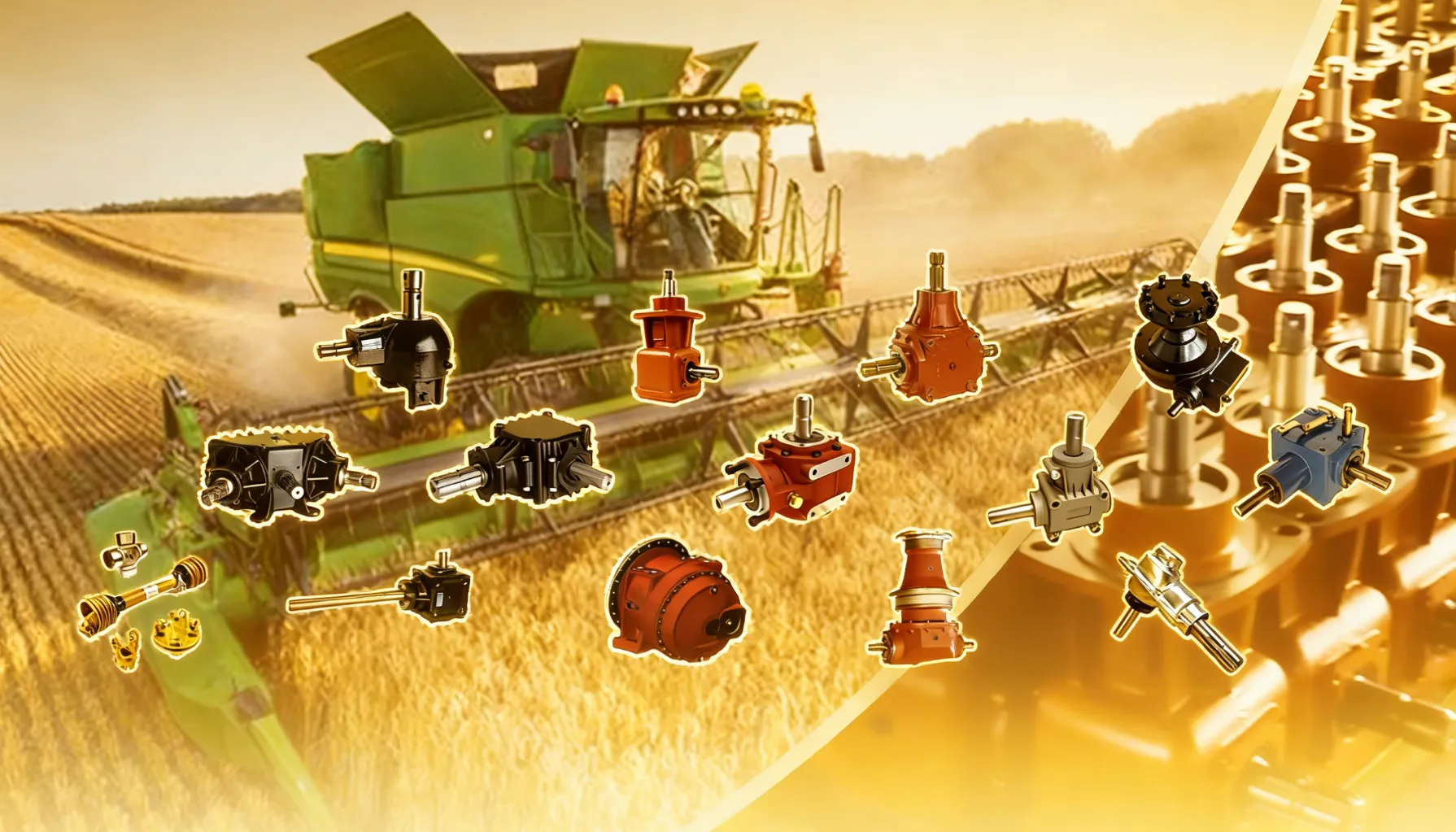
Agricultural and construction machinery places gearboxes in the most physically demanding environments they will encounter — exposed to mud, crop residue, abrasive soil, temperature extremes from −5°C winter frosts to 45°C summer afternoons, and shock loads from ground irregularities and material variation that no static bench test can replicate. This guide covers the selection, sizing, and maintenance of gearboxes for Australian agricultural and construction applications, from portable grain auger PTO drives to heavy construction equipment final drives.
PTO & Implement Gearboxes
Construction Equipment Drives
Grainbelt, Dairy & Civil Applications
Technical Specifications
Engineering parameters for gearboxes used in agricultural PTO implements and construction machinery, covering the range from small portable auger drives to heavy earthmoving equipment geartrains.
| Parameter |
Typical Range |
Notes |
| PTO Input Speed |
540 or 1,000 RPM |
Two standard tractor PTO speeds |
| Output Torque |
50 – 100,000 N·m |
Small spreader gearbox to heavy final drive |
| Service Factor |
1.5 – 3.0 |
Higher for implements hitting hard objects |
| Gear Types |
Bevel, worm, helical, epicyclic |
Application and direction-change dependent |
| Operating Temperature |
−10°C to +50°C ambient |
Australian seasonal extremes both ends |
| Lubrication |
EP 80W-90 or ISO VG 220–460 |
Multi-viscosity for seasonal temperature range |
Agricultural Gearbox Applications: PTO Implements and Field Equipment
The agricultural gearbox is perhaps the most diverse product category in the drivetrain world. A single farm operation may use PTO gearboxes on rotary tillers, mowers, hay balers, fertiliser spreaders, grain augers, and seeders — each with different ratio, direction change, and shock load requirements. Australia’s grainbelt, sugar industry, and dairy sector together represent one of the largest markets for agricultural drive components in the southern hemisphere.
PTO Implements: Right-Angle and Inline Drive Requirements
Tractor PTO implements connect to the tractor’s power take-off shaft — a splined shaft at 540 RPM or 1,000 RPM — and must redirect or reduce this speed to the implement’s working requirement. Rotary tillers, slashers, and mulchers use right-angle bevel gearboxes to take the inline PTO rotation and convert it to transverse cutting tool rotation, often with a speed reduction built into the bevel stage. Fertiliser spreaders and mist blowers use inline speed increasers. Hay balers use complex multi-output gearboxes with several power take-off points for different baler mechanisms. In all cases, the agricultural gearbox must tolerate the shock loads generated when a rotary tiller blade hits a buried rock, a mower deck contacts a hidden stump, or a baler chamber jams with wet crop — impulses that exceed the steady-state running torque by 5–10× and must be absorbed without gear tooth failure.
Grain Handling: Portable Augers and Fixed Installation Drives
Portable grain augers — the most common individual gearbox application across Australian grain farms — connect either to a tractor PTO or to a dedicated electric motor drive at the auger head, using a right-angle worm or bevel gearbox to reduce the input speed to the appropriate screw speed. Worm gearboxes are the standard for PTO-connected portable augers below 15 kW, providing compact right-angle reduction and inherent self-locking when the PTO disconnects. For electric-motor-driven fixed grain augers at receival silos, the sizing and installation approach follows the screw conveyor guidance, but the gearbox must also tolerate the seasonal cycle of intensive harvest use followed by months of idle storage — requiring synthetic oil or rust-inhibiting gear oil and greased-for-life bearings to prevent corrosion during the off-season.
Construction Machinery Gearbox Applications
Construction equipment gearboxes face a combination of high loads, continuous duty, and environmental exposure that represents a genuine engineering design challenge. Concrete mixers, compaction equipment, soil stabilisers, and earth-moving machine final drives all operate in conditions that accelerate wear and contamination relative to indoor industrial equipment.
Concrete Mixers & Batching Plants
Drum mixers and forced-action pan mixers use helical-bevel or worm gearboxes to drive the mixing drum or blade assembly at 15–25 RPM from a standard motor. Starting torque is high — a full drum of partially mixed concrete provides significant resistance at startup. Service factor 2.0 minimum; SF 2.5 for drum mixers that are regularly restarted under full load. Sealing against cement dust and water wash is critical — IP65 minimum throughout the drivetrain.
Soil Stabilisers & Recyclers
Soil stabilisers and cold in-place recyclers use a high-torque rotor drive gearbox to mix binder into road base material at depth. The rotor encounters embedded stones and varying material consistency, generating severe shock loads that demand SF 2.5–3.0 on the drive gearbox. Hydraulic final drives are common at this power level, but for electric or diesel-mechanical drives, multi-stage planetary or helical-bevel configurations are used to achieve the high reduction ratios from the engine speed to the slow rotor speed.
Compact Excavators & Final Drives
Compact excavator and skid steer track final drives use two-stage planetary gearboxes integrated into the track drive hub, providing the very high reduction ratios (80:1–180:1) needed to reduce hydraulic motor speed to practical track speed. These units are entirely hydraulically driven and do not fit the conventional electric motor / gearbox model — but their gear ratios, service factors, and maintenance requirements are directly comparable to other industrial gearbox applications.
Key Selection Criteria for Agricultural and Construction Duty
Agricultural and construction gearboxes share three selection requirements that distinguish them from standard industrial applications.
Shock Load Rating — The Primary Differentiator
Agricultural and construction gearboxes must absorb impact loads from ground contact, material variation, and mechanical jams that are fundamentally unpredictable in magnitude and frequency. Standard industrial service factors (1.25–1.5) are insufficient; agricultural implement gearboxes should be rated at SF 1.75–2.5 for normal soil conditions, rising to SF 3.0 for rocky ground or heavy-duty tillage. The shear bolt or slip clutch that protects the gearbox on rotary tillers and mowers is the last line of defence — the gearbox rating should not depend on these devices functioning correctly at every impact event.
Wide Temperature Tolerance
Australian agricultural operations span a temperature range from sub-zero winter starts in southern states to 45°C+ summer afternoons in Queensland. A single-viscosity gear oil that is appropriately viscous at 45°C may be far too thick to circulate adequately at −5°C on a cold-start, resulting in inadequate lubrication during the first minutes of operation when wear rates are highest. Multi-viscosity EP 80W-90 gear oil is the standard specification for year-round Australian agricultural gearbox service — it provides adequate cold-start fluidity and sufficient film thickness at maximum operating temperature.
Seasonal Storage Corrosion Prevention
Most agricultural implements are stored for 6–10 months between seasons. During this storage period, condensation within the gearbox can cause internal rust on gear tooth flanks and bearing raceways that is invisible externally but significantly reduces gear and bearing service life. Draining old mineral oil before storage and filling with a rust-inhibiting storage oil, or using synthetic oil that provides inherent rust protection, dramatically reduces storage corrosion. Sealing the breather with a temporary plug during extended storage prevents moisture-laden air cycling in and out as the gearbox casing temperature changes between day and night.
Sourcing Agricultural and Construction Gearboxes in Australia
Agricultural PTO gearboxes connect to the tractor via a matched PTO shaft whose yoke dimensions, cross-kit size, and spline specification must be compatible with both the tractor output and the gearbox input. Providing the PTO shaft connection data alongside the gearbox specification avoids the most common fit problem in agricultural drivetrain supply. For applications involving driveshaft connections between the tractor and implement, referencing accurate PTO shaft and CV joint specifications ensures the correct universal joint angle capacity and shaft length for the specific implement attachment geometry.
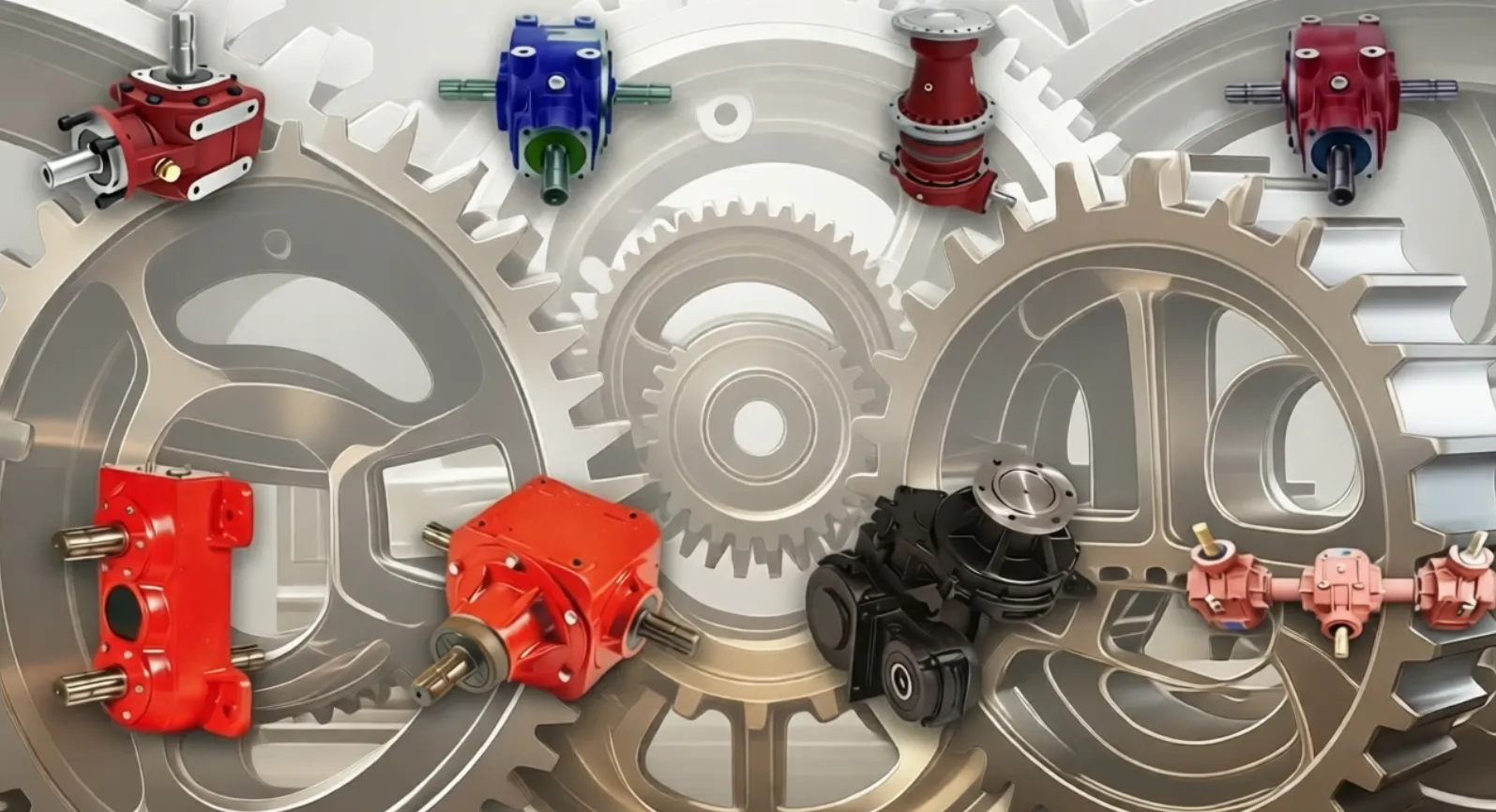
We supply agricultural PTO gearboxes, bevel gear heads for rotary implements, and worm gearboxes for grain auger and spreader applications across Australia. Browse configurations on our agricultural gearbox and implement drive solutions page, or contact our engineering team for a specification matched to your implement type and PTO connection.
Frequently Asked Questions
Common questions from farmers, agricultural engineers, and construction equipment maintenance managers across Australia.
1. What is the difference between a 540 RPM and 1,000 RPM PTO gearbox?
+
The two standard tractor PTO speeds are 540 RPM (standard, 6-spline 1-3/8” shaft) and 1,000 RPM (high-speed, 21-spline 1-3/8” or 20-spline 1-3/4” shaft). A gearbox designed for 540 RPM input will be damaged if connected to a 1,000 RPM PTO shaft — the input bearing, shaft seals, and gear mesh are sized for 540 RPM and the increased speed nearly doubles the centrifugal and contact stress on all rotating components. Most modern agricultural gearboxes state their rated input speed on the housing nameplate. For tractors with selectable PTO speed, always confirm which position is selected before engaging the PTO to a connected implement. Interchanging PTO connection components without verifying speed compatibility is the most common cause of instant agricultural gearbox failure in the field.
2. What gear oil should I use in an agricultural PTO gearbox?
+
EP 80W-90 gear oil (API GL-5 rated for extreme-pressure service) is the standard specification for agricultural PTO gearboxes and bevel gear heads across most Australian applications. The multi-viscosity grade provides adequate cold-start fluidity at −10°C and sufficient film thickness at 50°C operating temperature, covering the full seasonal range. For worm gear stages in agricultural applications (grain auger gearboxes, for example), ISO VG 220 worm gear oil or a GL-5 80W-90 both work, but the manufacturer’s specific recommendation should be followed — some worm gearboxes specify a different additive package than a bevel gear box to avoid copper corrosion in the bronze worm wheel. Never use ATF or hydraulic oil as a substitute — these lack the extreme-pressure additives required for hypoid and bevel gear tooth surfaces at agricultural impact loads.
3. Why do rotary tiller gearboxes have shear bolts, and how are they sized?
+
Shear bolts in the PTO connection flange are sacrificial overload protection devices — they are designed to shear cleanly at a defined torque that is above the normal running torque but below the torque required to fracture a gear tooth or crack a housing. When a rotary tiller blade hits a buried rock and the implement suddenly stalls, the shock torque propagates up the PTO shaft. The shear bolt fails first, preventing the impact from reaching the gearbox. The shear bolt diameter and material determine the shear torque — the manufacturer specifies both, and only the exact specified bolt grade and diameter should be used as a replacement. Using a stronger bolt “to avoid replacements” defeats the protection mechanism and results in the next impact destroying the gearbox instead of the bolt.
4. How do I prepare an agricultural gearbox for off-season storage?
+
Correct off-season storage extends gearbox service life substantially. Clean all external mud and crop debris from the housing and seals — buried debris holds moisture against the housing and accelerates corrosion. Check the oil level and top up if low; if the oil is contaminated (water ingress, milky appearance, metallic sediment), change it before storage rather than leaving contaminated oil to attack gear and bearing surfaces over winter. For storage longer than 3 months, temporarily plug the breather vent to prevent moisture-laden air cycling in and out as ambient temperature changes. At the start of the next season, remove the breather plug, check oil level, and run the implement for 5 minutes under no load before returning to full field work — this re-coats all internal surfaces with a fresh oil film before full load is applied to potentially dry surfaces.
5. What causes the oil seal on my grain auger gearbox to leak after only one season?
+
Early shaft seal failure on grain auger gearboxes has three common causes. First, overfilling — if the oil level is set above the correct mark, the higher internal oil pressure during operation pushes oil past the seal lip. This is particularly common after a top-up where the operator filled to the top of the fill port rather than the correct operating level. Second, seal degradation from UV exposure during storage — rubber seal lips exposed to ultraviolet light between seasons become hard and brittle, losing their conformability to the shaft surface. Third, abrasive grain dust contamination at the output shaft seal, which acts as a grinding compound on the seal lip. A simple fix is to add a small dust exclusion cover or felt ring just outside the lip seal at installation, keeping grain dust from directly contacting the seal lip surface.
6. How do I select a concrete mixer gearbox for a fixed batching plant?
+
For a fixed batching plant drum mixer, the key sizing inputs are the mixer drum capacity (m³), the required drum speed (typically 12–18 RPM for a transit-mix style drum, 4–8 RPM for a forced-action pan mixer), and the operating schedule. From drum speed and motor speed, the required ratio is straightforward. The critical sizing issue is starting torque: a full drum of partially mixed concrete at low temperature may require 3–4× the running torque to start rotating. For direct-on-line starters, this demands a service factor of 2.5 minimum on the gearbox. For VFD-controlled mixers with a torque-controlled ramp, SF 1.75–2.0 is adequate. Helical-bevel units are preferred over worm gearboxes on batching plant mixers above 7.5 kW due to their better thermal performance — concrete plants often run continuous batching schedules with minimal cooling periods.
7. What documentation should an agricultural PTO gearbox come with?
+
An agricultural PTO gearbox should ship with: a dimensional drawing showing all external dimensions including input spline specification and output shaft dimensions; rated input and output torques and speeds; oil type and fill volume; shear bolt specification if applicable (diameter, grade, shear torque, part number for replacement); IOM instructions covering installation, oil fill level, first-run procedure, and seasonal storage; and a spare parts diagram identifying the bearing part numbers and seal dimensions for field servicing. For OEM supply to implement manufacturers, material test certificates and PPAP (production part approval process) documentation may be required. For general farm equipment, a clear identification label on the housing stating the oil specification and fill volume is the most practically useful documentation item — it allows the farmer to correctly service the unit without referencing a manual.
8. Why do my hay baler gearboxes fail repeatedly at the same location?
+
Repeated failure at the same location in a hay baler drive train indicates a systemic problem with that specific mechanical position, not individual gearbox quality. The three most common systemic causes are: incorrect PTO shaft angle — the universal joints at the PTO connection should operate below 15° joint angle under normal working conditions; beyond this angle, the cyclic velocity variation in the cross-joint creates a torque pulsation at double the shaft rotation frequency that fatigues the downstream gearbox input shaft and bearing; oil contamination from a failed seal that was not replaced — contaminated oil accelerates gear wear and the problem recurs even after a new gearbox is installed; and wrong oil specification — using hypoid gear oil intended for spiral bevel applications in a straight bevel gearbox can cause seal degradation and additive incompatibility that shortens worm wheel life. Check all three before ordering the next replacement unit.
Get the Right Agricultural or Construction Gearbox
Share your implement type, PTO speed, required output speed, and operating conditions — our engineers will return a matched specification within one business day.
Request a Free PTO Gearbox Specification →
