Robot Arm & Joint Actuator Drive Systems · Precision Gearbox Engineering · Australia
Technical Application Reference
Robot joint actuators represent the precision extreme of the gearbox application spectrum. In a six-axis articulated robot, the gearbox at each joint must simultaneously provide high torque multiplication from a compact servo motor, near-zero backlash for positioning accuracy that is repeatable to fractions of a millimetre at the tool centre point, and the stiffness under load to prevent compliance errors from deflecting the arm away from its commanded path during cutting, welding, or assembly operations. These three requirements — torque, zero backlash, and stiffness — cannot be independently optimised in a single gear stage; achieving all three at once is the engineering challenge that makes robot joint gearboxes one of the most technically demanding and expensive gearbox categories in manufacturing. This guide covers the engineering basis for robot joint gearbox selection across Australian manufacturing, defence, and research automation applications.
Harmonic Drive, Cycloidal & Precision Planetary
Zero-Backlash & High Torsional Stiffness
Welding, Assembly, Painting & Collaborative Robots
Technical Specifications
Key parameters for robot joint actuator gearboxes, where backlash, torsional stiffness, and inertia ratio are specified alongside torque and ratio as primary performance criteria.
| Parameter |
Typical Range |
Notes |
| Backlash |
<1 arc-min (harmonic); 1–5 arc-min (planetary) |
Wrist joints require tightest; base joints can be looser |
| Output Torque |
10 – 10,000 N·m |
Small cobots at lower end; heavy-payload robots higher |
| Gear Ratio |
50:1 – 160:1 |
Single-stage harmonic achieves highest ratios |
| Torsional Stiffness |
Specified in N·m/arc-min |
Loaded deflection = accuracy limit under load |
| Positioning Repeatability |
±0.01 – ±0.1 mm at TCP |
Combined effect of backlash + stiffness at all joints |
| Lubrication |
Grease-lubricated (most joints) |
Sealed for life on many harmonic and cycloidal units |
Robot Joint Gearbox Technologies
Three gearbox technologies dominate robot joint actuator applications, each with a distinct performance profile that makes it the preferred choice for specific joint positions and robot types. Selecting the wrong technology for a joint position results in a robot that either cannot achieve the required positioning accuracy or has unnecessarily compromised payload or speed performance.
Harmonic Drive (Strain Wave Gearing): Zero Backlash at High Ratio
Harmonic drives (manufactured by Harmonic Drive SE, SHD, and HDSI) use an elastic deforming element (the flexspline) that engages a rigid circular spline through an elliptical wave generator. The gear ratio is determined by the difference in tooth counts between the flexspline (typically 200 teeth) and the circular spline (202 teeth), giving a ratio of 100:1 from a single flat stage. The tooth engagement is a continuous rolling contact across approximately 30% of the circumference at any time — producing the zero-backlash characteristic that makes harmonic drives the standard for robot wrist and elbow joints in precision applications.
The limitation of harmonic drives is the stiffness of the flexspline under torsional load. Because the flexspline deforms elastically during tooth engagement, its torsional stiffness is inherently lower than a rigid gear mesh — the output shaft deflects under load, and this deflection appears as a dynamic position error during high-acceleration moves. For robot joints carrying large payloads or subject to high-speed direction reversals, the harmonic drive compliance can become the dominant accuracy limitation. Manufacturers specify the torsional stiffness in N·m/arc-minute, and this value — combined with the maximum load torque — determines the maximum angular deflection under full load.
FANUC, ABB, KUKA, Yaskawa, and Staubli articulated robots all use harmonic drives in their wrist (J4, J5, J6) joints. FANUC uses proprietary harmonic drive units; ABB and KUKA use Harmonic Drive SE or equivalent OEM units. Replacement harmonic drive units for these robots are available from Harmonic Drive SE distributors in Australia and from specialist robot service providers.
Cycloidal Gearbox: High Stiffness, High Torque Density
Cycloidal gearboxes (Nabtesco RV series, Spinea, Sumitomo Cyclo) use a cycloidal disc that engages pins in an outer ring gear to produce speed reduction. The reduction is achieved through the difference between the number of pin rollers in the ring and the cycloidal disc lobes — similar in principle to a harmonic drive but with a rigid rather than elastic engagement element. Cycloidal gearboxes achieve higher torsional stiffness than harmonic drives for the same torque rating, making them the preferred technology for the shoulder (J1, J2, J3) joints of large industrial robots where the compliance of a harmonic drive would cause unacceptable deflection under the heavy arm and payload inertia.
Nabtesco RV gearboxes are used in approximately 60% of all industrial articulated robots globally — FANUC, Yaskawa Motoman, Mitsubishi, and Kawasaki all use Nabtesco units in their main axis joints. KUKA uses proprietary Sumitomo Cyclo-based gearboxes. ABB uses a proprietary cycloidal design in its larger robots. Replacement RV units for industrial robots in Australia are available through Nabtesco distributors and specialist robot maintenance suppliers. The unit must be matched by the RV series and reduction ratio code — available from the robot service manual or the joint nameplate.
Precision Planetary Gearbox: Versatile, Cost-Effective for Lower-Precision Joints
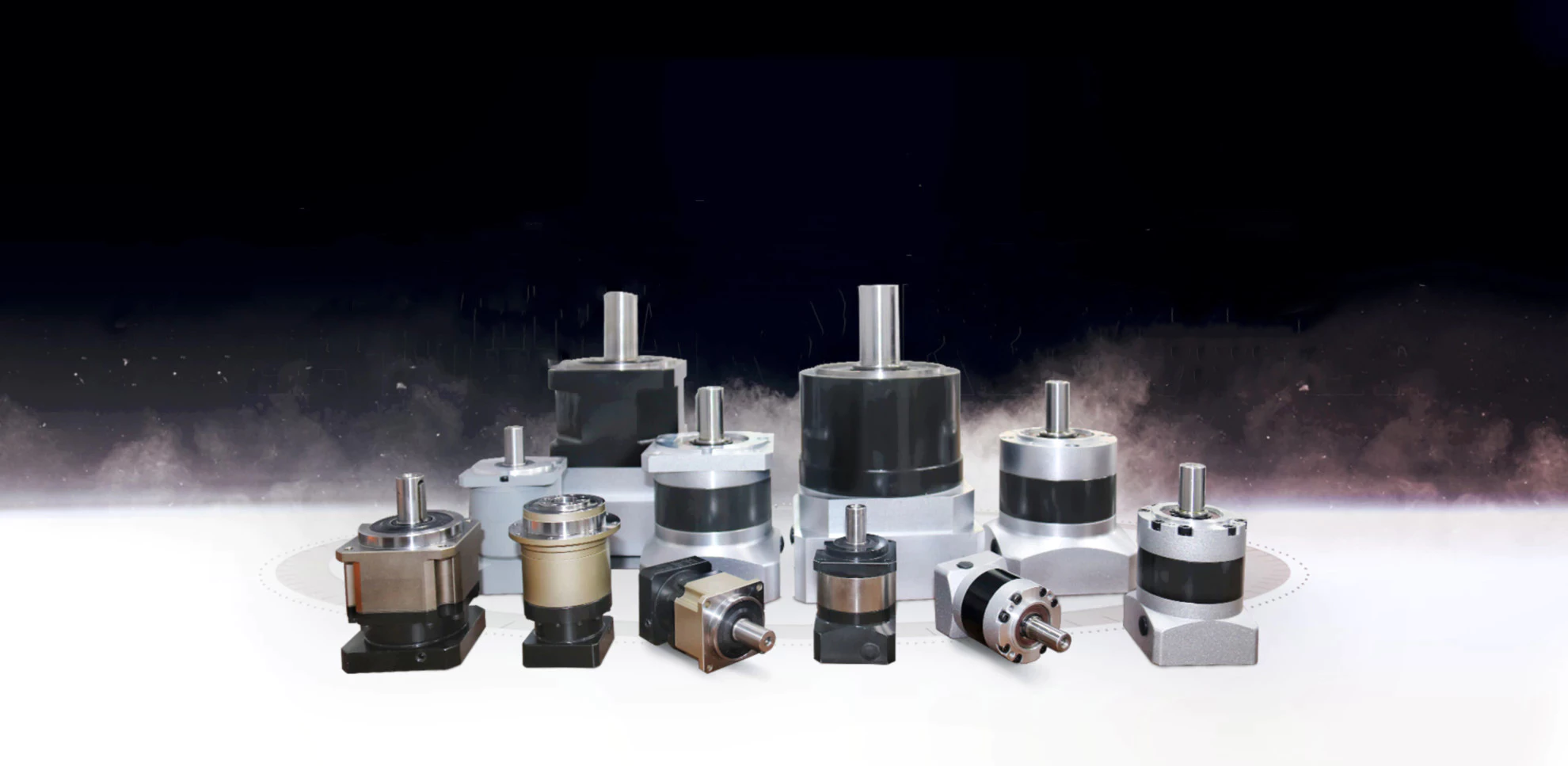
Precision planetary gearboxes (Neugart, Apex Dynamics, Wittenstein Alpha) provide low backlash (3–10 arc-minutes) and high torque density in a coaxial inline configuration that suits SCARA robots, linear axis actuators, and gantry robot joints where the inline form fits the installation geometry better than the right-angle output of a harmonic or cycloidal unit. Precision planetary gearboxes are used in collaborative robots (cobots) from Universal Robots, OMRON TM series, and ABB GoFa, where the lower backlash requirement of a cobot (compared to a high-speed industrial robot) allows a precision planetary to achieve adequate positioning accuracy at significantly lower cost than harmonic or cycloidal alternatives. The inertia ratio between the planetary gearbox’s reflected load inertia and the servo motor’s rotor inertia is the critical parameter for servo tuning bandwidth — a ratio above 10:1 makes the servo system difficult to tune for fast, responsive motion.
Selecting the Right Technology for Each Joint Position
Base & Shoulder Joints (J1–J3): Stiffness Priority
The base rotation (J1) and shoulder elevation (J2, J3) joints carry the full weight of the arm, wrist, tooling, and payload in a lever-arm relationship. Under load, any torsional deflection at these joints appears multiplied at the TCP by the full arm length. Cycloidal gearboxes (Nabtesco RV) are preferred for J1–J3 because their superior stiffness minimises this load-induced position error. The torque requirement is highest at these joints — a 50 kg payload on a 1.5 m reach requires approximately 750 N·m at the shoulder — and the cycloidal unit’s high torque density enables this within the arm’s structural envelope.
Nabtesco RV · Cycloidal · High stiffness · Heavy payload
Elbow & Wrist Joints (J4–J6): Zero-Backlash Priority
The forearm (J4) and wrist joints (J5, J6) determine the TCP orientation accuracy and the smoothness of path following near the tool. Backlash in these joints directly appears as TCP position uncertainty when the joint reverses direction — visible as a small “step” or “stutter” in the weld seam or the cutting path at each direction change. Harmonic drives (Harmonic Drive SE) are standard for J4–J6 because their zero-backlash characteristic is inherent to the flex-spline engagement, not a function of adjustment or preload. The lower stiffness is acceptable at these joints because the arm moment arm to the TCP is short.
Harmonic Drive SE · Zero backlash · Wrist orientation accuracy
SCARA & Cobot Joints: Planetary for Cost-Effectiveness
SCARA robots (Epson, Yamaha, IAI, Hiwin) and collaborative robots (Universal Robots UR series, ABB GoFa, OMRON TM, Doosan) have lower positioning accuracy requirements (±0.01–0.05 mm) than high-speed industrial 6-axis robots (±0.01–0.02 mm) and smaller payloads that reduce the load-induced stiffness requirement. Precision planetary gearboxes (Neugart PLE, Apex Dynamics AFR, Wittenstein Alpha) at 5–10 arc-minute backlash provide sufficient accuracy for these applications at 30–60% lower cost than harmonic or cycloidal alternatives.
Neugart / Apex · Precision planetary · Cobots · SCARA
Applications Across Australian Manufacturing and Research
Automotive & Defence Manufacturing
Automotive component manufacturers and defence equipment producers (BAE Systems, Rheinmetall MILVEHCOE) in Australia use FANUC, ABB, and KUKA industrial robots for welding, machining, and assembly. Robot joint gearbox replacement and maintenance requires specialist robot service providers with OEM-approved replacement components — Nabtesco RV for main axis joints, Harmonic Drive SE for wrist joints. Backlash degradation manifests as weld seam width variation or assembly tolerance drift over time.
Food & Pharmaceutical Automation
Collaborative robots (Universal Robots UR5/UR10, ABB GoFa) handling packaged goods, medication dispensing, and laboratory sample processing in Australian food and pharmaceutical facilities require precision planetary gearboxes with confirmed clean-room or washdown construction. Cobots operating in food contact zones need gear units with grease sealing rated to IP65 and certified lubricants compatible with the food safety environment. Joint gearbox replacement for cobots is typically a complete joint module replacement from the manufacturer’s service network.
University & Research Institutes
Australian universities (ANU, UTS, Monash, UWA) and CSIRO research divisions use robotic platforms for surgical simulation, terrain mapping, agricultural automation research, and laboratory automation. Custom-built research robots and exoskeletons use precision planetary or harmonic drive units from Neugart, Harmonic Drive SE, or Nabtesco as standard joint actuators. Research applications often require the gearbox documentation (backlash, stiffness, inertia) for dynamic modelling — request the full datasheet, not just the catalogue summary.
Mining Automation
Autonomous and semi-autonomous robotic systems for drill-and-blast, bolting, and inspection in Australian underground mines (Rio Tinto, BHP, Newcrest) use custom robot platforms and manipulators requiring precision joint gearboxes rated for vibration, dust, and temperature extremes beyond standard industrial robot specifications. Mining robot joint gearboxes must meet IP67 minimum sealing and must be serviced through modular replacement due to the access constraints of underground mine environments.
Sourcing Robot Joint Gearboxes in Australia
Robot joint actuator gearbox specifications must include: backlash (arc-minutes, at stated test torque and temperature); torsional stiffness (N·m/arc-minute); peak and rated output torque; gear ratio; reflected inertia ratio to servo motor rotor inertia; mounting flange standard (IEC or custom); and for harmonic and cycloidal units, the manufacturer series and size code (e.g., Nabtesco RV-20E, Harmonic Drive CSF-25-100). Full technical data for precision worm gear reducers applicable to lower-cost robot and automation positioning axes is available at our worm gear reducer technical specifications resource. We supply precision planetary gearboxes, harmonic drive units, and cycloidal reducers for robot joint actuator applications across Australia. Browse on our robot joint actuator drive solutions page, or contact our engineering team with your backlash, stiffness, and torque requirements for a matched specification within one business day.
Frequently Asked Questions
Common questions from robot integrators, automation engineers, and researchers about robot joint gearbox selection, replacement, and performance.
1. How does backlash in a robot joint gearbox affect the TCP positioning accuracy?
+
Backlash in a robot joint produces a dead band at each direction reversal where the servo motor moves through the backlash angle without any corresponding output motion. The TCP position error from backlash at a joint = backlash angle (radians) × distance from joint to TCP. For a wrist joint (J5) with 10 arc-minutes of backlash and a 200 mm tool length beyond the wrist: TCP error = (10 / 3,438) × 200 = 0.58 mm. For a shoulder joint (J2) with the same backlash and a 1,200 mm reach to TCP: TCP error = (10 / 3,438) × 1,200 = 3.5 mm. This explains why wrist joints demand zero-backlash harmonic drives (the arm moment arm amplifies any backlash), and why shoulder joints can use slightly higher-backlash cycloidal units (the position error at the TCP from a given shoulder joint backlash is acceptable at typical industrial robot accuracy specifications).
2. When should I choose a cycloidal over a harmonic drive for a robot joint?
+
Choose a cycloidal unit (Nabtesco RV, Spinea) over a harmonic drive when: the joint torque exceeds approximately 1,000 N·m (harmonic drives become very large and expensive above this torque); the joint is subject to high-frequency, high-amplitude direction reversals that stress the harmonic drive flex spline in fatigue (this is particularly relevant for large robots with heavy payloads doing fast pick-and-place cycles); or when torsional stiffness under load is more important than absolute zero backlash — cycloidal units have 3–5× higher torsional stiffness than comparable harmonic drives, reducing load-induced position error in joints where compliance matters more than backlash (such as shoulder joints). Choose a harmonic drive when: the joint needs zero backlash for appearance-quality welding, precision dispensing, or sub-millimetre assembly; the joint space is severely constrained (harmonic drives achieve higher ratios in smaller axial space than cycloidal); or when the joint cycle count will exceed 10 million reversals at moderate load, where the harmonic drive’s fatigue life advantage is relevant.
3. How do I know when a robot joint gearbox needs replacement rather than recalibration?
+
The distinction between recalibration and gearbox replacement is whether the position error is compensatable by the robot controller or is a mechanical wear symptom. If the TCP position error is consistent — the same error in the same direction at every repeat — it is a zero-point calibration drift that can be corrected by re-running the robot’s mastering procedure. If the error is variable — different at each repeat, or larger when the joint reverses direction than when it moves in a single direction — it is a backlash or bearing wear symptom that recalibration cannot fix. A simple backlash test: command a joint to a known position from both directions and compare the final positions; if they differ by more than twice the robot’s rated positioning repeatability, backlash has increased beyond the controller’s compensation capability and the gearbox requires replacement. For most industrial robots, a single joint gearbox replacement (not whole arm replacement) resolves accuracy degradation if the affected joint is correctly identified through this test.
4. What is the correct service life expectancy for a robot joint harmonic drive?
+
Harmonic Drive SE rates their CSF and CSD series units at 10,000–15,000 operating hours (combined input revolution count) at rated torque — equivalent to approximately 3–5 years on a two-shift automotive welding robot at rated payload. The actual service life depends critically on the ratio of applied torque to rated torque: a joint running at 50% of rated torque achieves substantially longer life than the rated value, while a joint regularly exceeding rated torque in emergency deceleration cycles degrades faster. Many robot manufacturers recommend harmonic drive unit replacement based on cumulative duty (counted by the robot controller) rather than calendar time — if the robot controller supports this, use the cumulative duty counter as the replacement trigger rather than a fixed time interval. At the end of service life, the flexspline fatigue cracks — producing a sudden backlash increase and eventually complete joint failure. There is rarely visible external warning before this failure.
5. What documentation should a robot joint gearbox supplier provide?
+
A robot joint gearbox delivery package should include: backlash specification at the stated test torque and temperature; torsional stiffness curve (N·m vs arc-minute deflection); peak and rated output torque; gear ratio; reflected inertia to servo input; dimensional drawing with flange and shaft dimensions to confirm robot compatibility; lubricant type and grade (critical — do not substitute without manufacturer approval); rated operating temperature range; and for harmonic and cycloidal units, the cumulative input revolution count at rated torque (service life basis for replacement scheduling). For custom-built robot and automation platforms at Australian research and defence facilities, additionally provide a dynamic model parameter set (stiffness, damping, inertia) in the format required by the robot’s simulation and control software to enable accurate trajectory planning with the gearbox compliance modelled.
Get Robot Joint Gearboxes Specified for Your Accuracy and Load Requirements
Share your robot brand, joint position (J1–J6), payload, accuracy requirement, and cycle rate — our engineers will return a specification with backlash, stiffness, and inertia ratio confirmation for your specific application within one business day.
Request a Free Robot Joint Gearbox Specification →
