Description
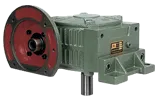
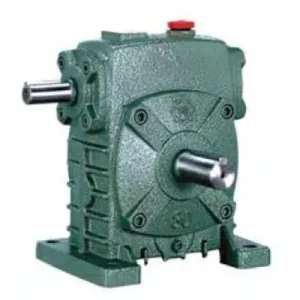
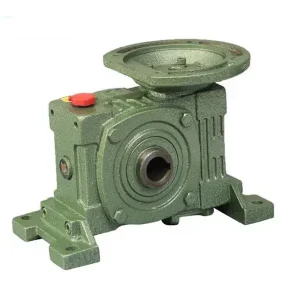
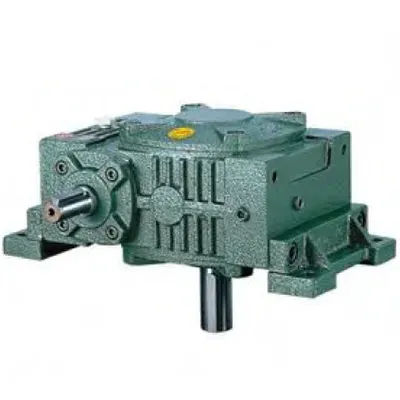
The WX & WO Series worm gear reducer is the most fully integrated configuration in the W family — combining the W series’ signature through-shaft solid input accessible from both sides with dual hollow bore outputs that mount directly onto the two driven machine shafts. The WO presents two co-axial hollow bores on opposite housing faces, mechanically guaranteeing identical speed on both driven shafts at all times from a single reducer and motor. The WX provides one co-axial hollow bore and a second at 90° via an internal bevel stage, addressing machine geometries where parallel dual outputs are not possible. Together, WO and WX deliver what no other single W series unit provides: zero output couplings, mechanically synchronised twin loads, and motor input flexibility from either side of the housing — all within the W family dimensional convention that legacy Australian industrial machinery was originally designed around. Covering sizes 40 through 135, gear ratios 10:1 to 60:1, manufactured to ISO 9001:2015 and designed per AGMA 6034 — supplied by Ever-Power Worm Gear Reducer Co., Ltd. (Australia), 27 Harley Crescent, Condell Park NSW 2200.

Key Specifications & Parameters — WX & WO Series Worm Gear Reducer
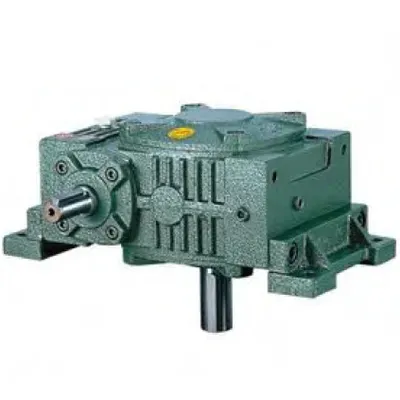
WO Series — Co-Axial Dual Hollow Bore
Through-shaft input (either side) + two co-axial hollow bore outputs on opposite housing faces. Both bores rotate at mechanically identical speed. For symmetrical parallel twin-driven loads in W series machine envelopes.
WX Series — 90° Dual Hollow Bore
Through-shaft input (either side) + two hollow bore outputs at 90° offset. One bore co-axial with input axis; second bore exits perpendicular via bevel stage. For L-shaped twin-drive layouts in legacy W series machines.
| Size | Ratio | Centre Dist. A (mm) | Overall Length B (mm) | Height H (mm) | Bore Depth HL (mm) | Input Shaft Ø (mm) | Output Bore Ø (mm) | Weight (kg) |
|---|---|---|---|---|---|---|---|---|
| 40 | 10:1–60:1 | 148 | 123 | 45 | 72 | 25 | Ø14 | 4.2 |
| 50 | 10:1–60:1 | 175 | 145 | 50 | 90 | 30 | Ø17 | 6.5 |
| 60 | 10:1–60:1 | 195 | 165 | 55 | 102 | 40 | Ø22 | 9 |
| 70 | 10:1–60:1 | 234 | 195 | 65 | 120 | 40 | Ø28 | 14 |
| 80 | 10:1–60:1 | 264 | 210 | 70 | 140 | 50 | Ø32 | 21 |
| 100 | 10:1–60:1 | 322 | 253 | 90 | 165 | 50 | Ø38 | 33 |
| 120 | 10:1–60:1 | 385 | 285 | 100 | 195 | 65 | Ø45 | 51 |
| 135 | 10:1–60:1 | 435 | 320 | 110 | 230 | 75 | Ø55 | 75 |
What Are the WO and WX — The W Family’s Maximum Interface Density
The WO and WX represent the apex of the W family’s interface options. To understand their position, consider the full W family interface matrix:
| W Family Model | Input | Output Count | Output Type |
|---|---|---|---|
| W / WPW | Through-shaft (both sides) | Single | Solid shaft |
| WA / WS | Through-shaft (both sides) | Single | Hollow bore |
| WD (FCWD) | IEC flange (single side) | Single | Solid shaft (W-class) |
| WO | Through-shaft (both sides) | Dual co-axial | Dual hollow bore |
| WX | Through-shaft (both sides) | Dual 90° offset | Dual hollow bore |
The WO and WX complete the W family by addressing the one interface combination not available in any other W series configuration: dual hollow bore outputs with through-shaft input flexibility. In the WP family, the WPO and WPX provide dual hollow bore outputs but with single-side shaft input (requiring a motor from one fixed direction). The WO and WX provide the same dual hollow bore outputs but with the W series’ through-shaft input — the motor can couple to either side of the housing, giving the machine designer complete flexibility in motor positioning while still eliminating both output couplings and guaranteeing mechanical speed synchronisation between the two driven loads.
The WO produces mechanically exact identical speed on both output bores at all times because both bores are the same physical worm wheel shaft — there is no gear, chain, or belt between them. This is a fundamental physical guarantee, not an electronic approximation, and cannot drift, drift under load, or fail due to a sensor or controller fault. For Australian machinery builders specifying twin-roll conveyors, symmetrical tension rollers, or balanced dyeing ranges in legacy W series machine envelopes, this mechanical synchronisation in the W dimensional convention is the core value of the WO.
How to Select WO or WX — Decision Guide for Australian Engineers
- WO or WX? If both driven shafts are co-axial (extending from opposite sides of the reducer on the same axis), specify WO. If the second driven shaft is at 90° to the first (L-shaped layout), specify WX. The through-shaft input is available from either side in both variants — motor positioning is separate from this output geometry decision.
- Confirm Bore Diameters: WO has identical bore diameters on both output faces. WX may have different bore diameters on the co-axial and 90° outputs — confirm with Ever-Power’s engineering team. Provide both driven shaft diameters when ordering.
- Calculate Total Torque: The WO/WX rated output torque is the total available across both bores. Sum both output load torques (with service factors applied) and confirm the total does not exceed the WO/WX frame rated output torque. For unequal loads, also confirm neither individual bore torque exceeds the shaft capacity — specify a torque-limiting coupling on the lighter-loaded bore if load imbalance risk exists.
- Legacy Machine Replacement: If replacing an existing WO or WX unit, provide the existing unit’s centre distance and bore diameters to Ever-Power for a confirmed interchange check. The W series bore diameters differ from the WP series (WPO/WPX) at equivalent frame sizes.
- Guard Unused Input Stub: The through-shaft input extends from both sides. Fit the unused side with a stub shaft cover plate per AS 4024.1 before commissioning.
Accessories We Also Supply: Through-shaft stub cover plates, torque arm kits (WO and WX specific), shrink disc assemblies (bore Ø22+), jaw couplings for through-shaft input, replacement oil seals, and DIN 6885 parallel keys. Contact Ever-Power Australia.
WO & WX Applications in Australian Industry
- Legacy Twin-Roll Conveyor Replacement (All States): Australian food, packaging, and materials handling facilities operating WO or WX units in machinery built around the W dimensional convention require W-family bore dimensions for replacement — the WPO/WPX (WP series dual output) uses different bore diameters and would not interchange. Ever-Power WO and WX units provide true like-for-like replacement in these facilities.
- New Twin-Shaft Drives in W-Convention Machines (Sydney, Melbourne): When upgrading or expanding a machine originally built around W series dimensional standards, the WO preserves dimensional consistency across the whole machine — no adaptor brackets, no bore size mismatches, and no dimensional reference drawings to update.
- Dyeing and Textile Finishing (Melbourne, Geelong): Fabric spreader rolls, stenter pin-rail drives, and tension equalisation roller systems in W-series-equipped dyeing ranges, where WO’s mechanically identical bore speeds guarantee fabric width consistency without electronic speed correction.
- Agricultural Twin-Rotor Implements (QLD, NSW, WA): Twin-rotor cultivators, dual-auger spreaders, and twin-roller seed crushers where the WX’s 90° second bore allows motor mounting above the implement frame while both rotors exit at ground level — a clean layout in legacy implement frames originally designed around the W series.
- Industrial Gate and Flood-Gate Actuation (Perth, Adelaide, Brisbane): Twin-rack gate drives in irrigation and water treatment infrastructure where both rack-pinion outputs must advance at identical rates. The WO’s mechanical synchronisation eliminates the differential advance that causes gate racking in electronically synchronised systems.
What Australian Customers Say About the WO & WX Series
“Replaced WO 80 units in our Sydney food plant — 15-year-old W series twin-roll conveyors. The Ever-Power WO 80 went straight in with the original bore dimensions, original torque arms, no modifications. Mechanical speed sync is still perfect 14 months later. Zero electronic corrections needed since the rebuild.”
— Tony B., Engineering Manager, Sydney NSW
“WX 100 on our Melbourne textile stenter pin-rail drive. The 90° output places the motor at the machine top while the WX’s two bores feed both sides of the stenter frame symmetrically. Replaced a WX unit that had been running 25 years — Ever-Power WX is an exact dimensional match.”
— Ruth H., Maintenance Engineer, Melbourne VIC
“WO 70 units on our QLD dual-auger spreader implements. The through-shaft lets us connect either from the tractor PTO side or from a secondary electric motor depending on the application. 4 stars only because delivery of size 135 took 12 days — standard sizes (70, 80, 100) were 7 days.”
— Barry G., Implement Engineer, Emerald QLD
“WO 100 on our Perth water treatment gate drives. Both rack outputs must advance identically — the mechanical synchronisation of the WO means we don’t need a synchronisation control loop and there’s no risk of differential advance jamming the gate in its guides. Rock-solid operation for 2 years.”
— Fiona D., Infrastructure Engineer, Perth WA
Why Choose Ever-Power for WO & WX Worm Reducers in Australia?
Ever-Power Worm Gear Reducer Co., Ltd. (Australia) at 27 Harley Crescent, Condell Park NSW 2200 stocks WO and WX units across all eight frame sizes with 5–10 business day dispatch. Our engineering team provides free legacy interchange confirmations against existing W series WO/WX units and WO vs WX configuration guidance. Visit About Us and technical reference at worm-gearbox.top.