Description
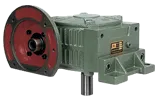
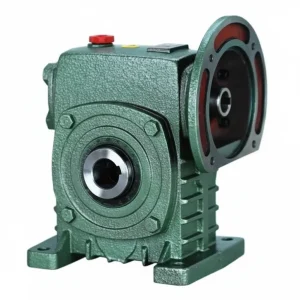
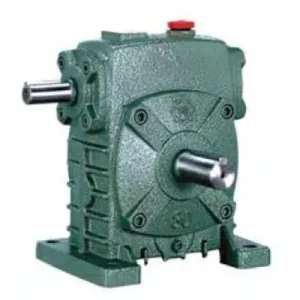
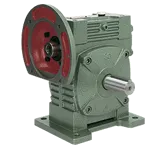
The WDA & WDS Series (FCWDA / FCWDS) worm gear reducer achieves maximum drive integration within the W family dimensional convention: an IEC B5 motor-mounting flange at the input side eliminates the input coupling, while a hollow bore output eliminates the output coupling — resulting in a completely coupling-free drive train within the W series housing geometry. The FCWDA pairs the IEC flange with a WA-class bore depth, suited to smooth continuous loads where motor-direct convenience is the priority. The FCWDS upgrades the output to the WS-class deeper bore, delivering greater key engagement area, superior fretting resistance under shock and reversing torque, and the higher overhung load tolerance that chain-loaded conveyors, grain auger drives, and screw conveyor applications demand — all while retaining the IEC motor direct mount of the FCWDA. For Australian manufacturers and plant engineers across Sydney, Melbourne, Brisbane, Adelaide, and Perth who need both coupling-free interfaces in the W series dimensional envelope, the WDA/WDS is the answer. Covering sizes 50–155, input powers 0.18–5.5 kW, bore diameters Ø17–Ø60 mm, and ratios 10:1–60:1. Manufactured to ISO 9001:2015, designed per AGMA 6034, and supplied by Ever-Power Worm Gear Reducer Co., Ltd. (Australia), 27 Harley Crescent, Condell Park NSW 2200.
Key Specifications & Parameters — WDA & WDS Series (FCWDA / FCWDS)
FCWDA — WA-Class Bore Depth
IEC B5 flange input + WA-class hollow bore output (HL-WDA). Motor-direct convenience + standard bore engagement. Best for smooth continuous loads in compact coupling-free drive designs.
FCWDS — WS-Class Bore Depth
IEC B5 flange input + WS-class deeper hollow bore output (HL-WDS). Same motor-direct convenience with up to 50% deeper bore engagement. Best for shock, chain-drive, and reversing loads.
All parameters per ISO 9001:2015, AGMA 6034, and IEC 60034-7. Bore tolerance H7/DIN 286. Output bore Ø is identical for FCWDA and FCWDS — only bore depth (HL) differs.
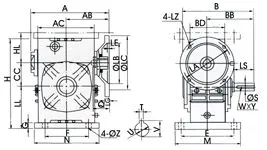
| Size | Power (kW) | Ratio | A (mm) | B (mm) | H (mm) | HL-WDS (mm) | HL-WDA (mm) | Flange LA (mm) | Bore Ø (mm) | Weight (kg) |
|---|---|---|---|---|---|---|---|---|---|---|
| 50 | 0.18 | 10:1–60:1 | 165 | 175 | 165 | 80 | 50 | 115 | Ø17 | 7 |
| 60 | 0.37 | 10:1–60:1 | 185 | 190 | 195 | 93 | 60 | 130 | Ø22 | 11 |
| 70 | 0.37–0.75 | 10:1–60:1 | 209 | 210 | 233 | 108 | 73 | 130 | Ø28 | 15 |
| 80 | 0.75–1.5 | 10:1–60:1 | 242 | 240 | 268 | 123 | 83 | 165 | Ø32 | 23 |
| 100 | 1.5 | 10:1–60:1 | 310 | 263 | 330 | 150 | 100 | 165 | Ø38 | 38 |
| 120 | 2.2–3.0 | 10:1–60:1 | 361 | 315 | 395 | 180 | 120 | 215 | Ø45 | 65 |
| 135 | 3.0–4.0 | 10:1–60:1 | 412 | 335 | 455 | 215 | 135 | 215 | Ø55 | 84 |
| 155 | 5.5 | 10:1–60:1 | 442 | 402 | 493 | 235 | 135 | 265 | Ø60 | 120 |
Green HL-WDS = FCWDS deep bore depth. Indigo HL-WDA = FCWDA standard bore depth. Output bore Ø is shared by both variants at each frame size.
What Are FCWDA and FCWDS — W Family’s Coupling-Free Pair

The FCWDA and FCWDS complete the W family’s configuration matrix by providing the same zero-coupling design that the WPDKA and WPDKS provide in the WP family, but within the W series dimensional convention — a critical distinction for Australian facilities running legacy machinery built around W series bore dimensions (Ø17–Ø60 mm) that differ from WP family bores (Ø20–Ø70 mm) at equivalent frame sizes.
The FCWDA is the W family’s equivalent of the WPDKA — IEC flange input combined with WA-class bore depth (HL-WDA). It suits applications where the driven shaft is smooth-loaded, the bore engagement requirement falls within the HL-WDA depth, and motor-direct convenience is the priority. The FCWDS is the W family’s equivalent of the WPDKS — the same IEC flange input, but with the WS-class deeper bore and the higher shock and fretting resistance it provides. At size 100, the FCWDS’s HL-WDS of 150 mm provides 50% more key engagement area than the FCWDA’s HL-WDA of 100 mm — directly extending bore life under cyclic and shock loading common in Australian chain conveyor and auger drives.
W Family Complete Interface Matrix — Where FCWDA/FCWDS Fit
| W Family Model | Motor Input | Output | Bore Depth | Couplings Eliminated |
|---|---|---|---|---|
| WA | Through-shaft coupling | Hollow bore (WA depth) | Standard | Output only |
| WS | Through-shaft coupling | Hollow bore (WS depth) | Deep | Output only |
| FCWD | IEC B5 flange | Solid shaft (W-class) | N/A | Input only |
| FCWDA | IEC B5 flange | Hollow bore (WA depth) | Standard | Input AND output |
| FCWDS | IEC B5 flange | Hollow bore (WS depth) | Deep | Input AND output |
How to Select FCWDA or FCWDS — Selection Guide
- FCWDA or FCWDS? Apply the same WA vs WS decision criteria: FCWDA for smooth continuous loads (SF ≤ 1.25, no shock, no chain/belt output); FCWDS for shock, reversing, or chain-loaded outputs (SF ≥ 1.5). When in doubt on a new design, specify FCWDS — the deeper bore costs ~8–12% more but provides measurably superior bore life under all loading conditions.
- W Family or WP Family? Specify FCWDA/FCWDS (W family) when: replacing existing FCWDA/FCWDS units; the machine uses W series bore dimensions (Ø17–Ø60 mm at these frame sizes); W-class housing mounting is required. Specify WPDKA/WPDKS (WP family) for new designs without legacy dimensional constraints, where IEC cross-brand interchange is a procurement priority.
- Confirm Both Interfaces: Verify the IEC motor frame against the FCWDA/FCWDS flange acceptance range AND verify the driven shaft diameter against the standard bore Ø for your chosen frame. Both must be satisfied — if the motor frame requires a larger flange than the standard FCWDA accepts, move to the next frame size.
- Bore Engagement Check: Confirm driven shaft engagement length ≤ HL-WDA (FCWDA) or HL-WDS (FCWDS). For FCWDS, verify shaft length against HL-WDS at your chosen frame size — the deeper bore allows longer shaft engagement, improving fretting resistance.
- Thermal Check for Australian Conditions: Derate thermal rated power by 10% per 10 °C above 20 °C reference. Specify synthetic ISO VG 220 oil for Queensland, WA, and NT summer environments where ambient exceeds 35 °C.
Accessories We Also Supply: IEC adaptor rings for non-standard motor frames, W-family torque arm kits (FCWDA and FCWDS specific), shrink disc assemblies (Ø22+ bores), motor support brackets (frame 100+), DIN 6885 parallel keys, and Viton bore seals. Contact Ever-Power Australia for pricing.
FCWDA & FCWDS Applications in Australian Industry
- Legacy W-Convention Machine Upgrades (All States): Australian food, packaging, and conveyor machinery built around W-series hollow bore units (WA/WS) can adopt IEC motor direct mount by upgrading to FCWDA/FCWDS — retaining all existing driven shaft dimensions while eliminating input couplings, motor bases, and alignment procedures.
- Packaging and Food Processing (Sydney, Melbourne, Brisbane): FCWDA units on conveyor roller drives, mixer agitator shafts, and filling auger drives where IP65 IEC motors flange directly to the reducer and driven shafts mount directly into the bore — zero coupling surfaces for AS/NZS 4696 food safety compliance.
- Grain and Agricultural Auger Drives (QLD, NSW, SA): FCWDS at sizes 80–120 on grain auger head shafts where the IEC motor must flange directly to the compact reducer housing and the shaft engagement length and shock loading both exceed what the FCWDA provides. The WS-class deeper bore and higher fretting resistance handle sustained harvest-season reversing and stone-strike loads.
- Water Infrastructure Gate and Valve Drives (Perth, Adelaide): FCWDA at sizes 100–135 at 40:1–60:1 on W-convention gate actuator systems where modern IEC brake motors must replace obsolete coupled motors without machine base modification — and where the hollow bore eliminates the output coupling that previously required regular maintenance.
What Australian Customers Say About the WDA & WDS Series
“Replaced WA units in our Sydney food plant with FCWDA — retained the W-convention bore dimensions on our existing shafts and eliminated the input coupling at the same time. Installation per drive dropped from 90 minutes to 18 minutes. Zero alignment tools needed. Should have done this years ago.”
— Lisa P., Engineering Manager, Sydney NSW
“FCWDS 100 at 30:1 on our Brisbane grain auger drive. The WS-class bore depth handles our auger shaft engagement length plus the stone-strike loads that wore out two FCWDA units in 14 months. Now 20 months in with zero bore damage. The deeper bore made all the difference.”
— Keith M., Grain Storage Engineer, Brisbane QLD
“FCWDA 80 on our Melbourne packaging conveyor roller drives. IEC 80B5 brake motor flanges straight on, roller shaft goes directly into the bore. Very clean installation, passed our food safety audit. 4 stars because we needed to confirm whether FCWDA or FCWDS — a quick OHL comparison table in the catalogue would save that call.”
— Peter N., Packaging Engineer, Melbourne VIC
“Upgrading W-convention gate actuator drives in Perth water infrastructure. The FCWDA 135 at 60:1 with modern IEC brake motor drops straight into the original W-series machine base — no modifications. Motor swap during maintenance is 15 minutes now versus 2 hours with the old setup.”
— Colin R., Infrastructure Engineer, Perth WA
Why Choose Ever-Power for WDA & WDS Worm Reducers in Australia?
Ever-Power Worm Gear Reducer Co., Ltd. (Australia) at 27 Harley Crescent, Condell Park NSW 2200 stocks FCWDA and FCWDS units across common frame sizes for 5–10 business day dispatch. Our engineering team provides free dual-interface checks (IEC flange + bore) and FCWDA vs FCWDS selection analysis simultaneously. Visit About Us and worm-gearbox.top.