Description
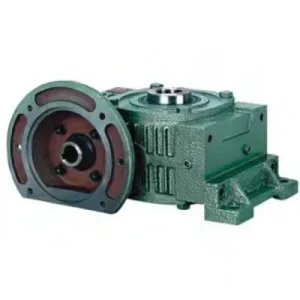
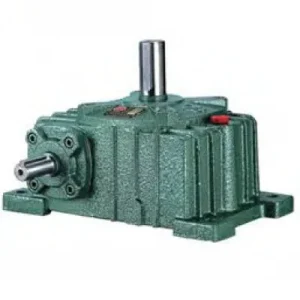
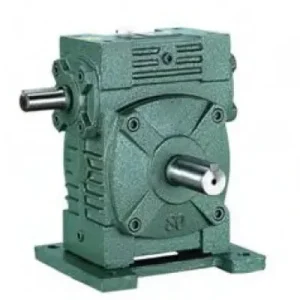
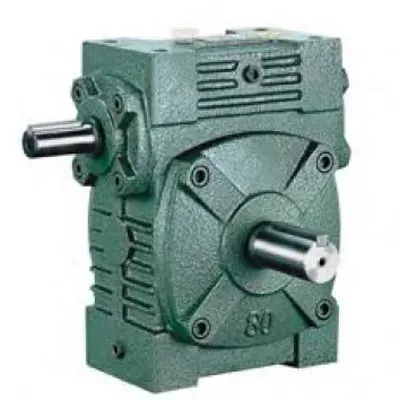
The W Series Worm Gearbox (WPW) is the compact universal-mounting member of the W family — a right-angle worm reducer that preserves the W series’ proven through-shaft solid input geometry while delivering a significantly lighter housing, omnidirectional mounting capability, and a compact overall envelope suited to machine designs where the heavier standard W series footprint is impractical. Where the standard W series (W/WA/WS) uses a deeper, taller housing that prioritises output shaft section and bearing span, the WPW compact variant uses a proportionally smaller housing that reduces weight by up to 75% at equivalent frame sizes — making it the preferred choice for elevated mounts, portable machinery, and machine designs where the standard W series is too heavy or too tall to fit. Covering centre distances from size 40 through 155, gear ratios from 10:1 to 60:1, and through-shaft input accessible from both housing sides as standard, the WPW is widely deployed by Australian manufacturers in Sydney, Melbourne, Brisbane, Adelaide, and Perth across food processing, packaging, textile, and woodworking machinery. Manufactured to ISO 9001:2015, designed per AGMA 6034, and supplied by Ever-Power Worm Gear Reducer Co., Ltd. (Australia), 27 Harley Crescent, Condell Park NSW 2200.
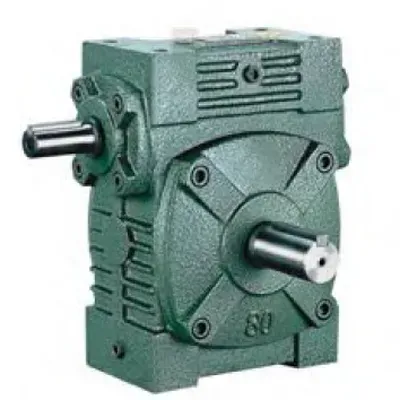

Key Specifications & Parameters — W Series Worm Gearbox (WPW)
All parameters per ISO 9001:2015 and AGMA 6034. Through-shaft input standard on both sides. Output shaft is solid, single side.
| Size | Ratio Range | Centre Dist. A (mm) | Overall Length B (mm) | Height H (mm) | Input Stub HL (mm) | Input Shaft Ø HS (mm) | Output Shaft Ø (mm) | Weight (kg) |
|---|---|---|---|---|---|---|---|---|
| 40 | 10:1–60:1 | 148 | 122 | 125 | 35 | 25 | 28 | 3.5 |
| 50 | 10:1–60:1 | 175 | 145 | 150 | 35 | 30 | 40 | 6.0 |
| 60 | 10:1–60:1 | 195 | 165 | 177 | 42 | 40 | 50 | 8.5 |
| 70 | 10:1–60:1 | 234 | 195 | 215 | 55 | 40 | 60 | 12.5 |
| 80 | 10:1–60:1 | 264 | 210 | 250 | 65 | 50 | 65 | 20 |
| 100 | 10:1–60:1 | 322 | 245 | 310 | 80 | 50 | 75 | 33 |
| 120 | 10:1–60:1 | 385 | 285 | 370 | 95 | 65 | 85 | 50 |
| 135 | 10:1–60:1 | 435 | 320 | 425 | 105 | 75 | 95 | 77 |
| 155 | 10:1–60:1 | 494 | 387 | 461 | 103 | 85 | 110 | 100 |
What Is the WPW W Series Worm Gearbox — Compact Universal vs Standard W Series
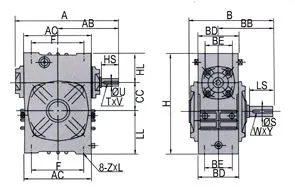
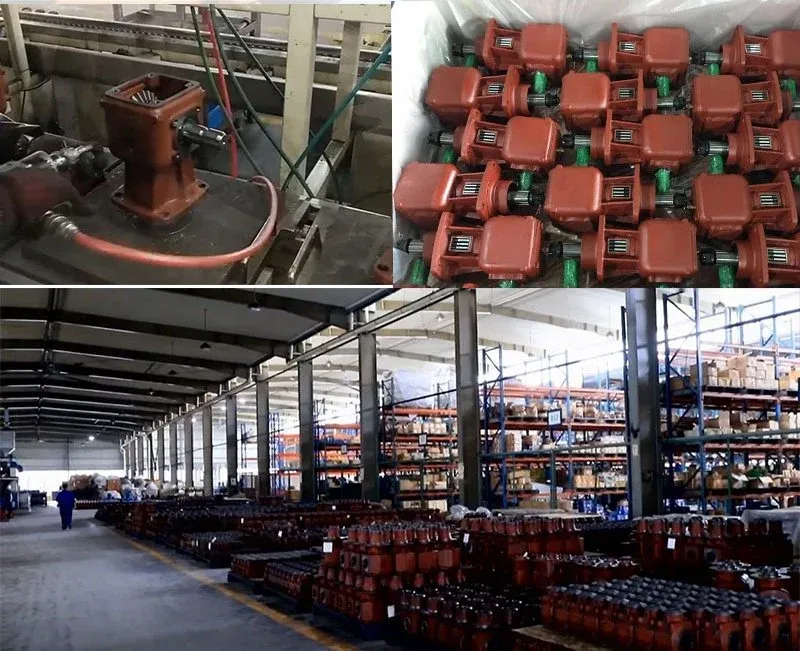
The WPW is the compact, lighter-weight variant within the W family dimensional convention. In the model designation, W identifies the worm reducer family, P identifies the box structure type, and the second W denotes the universal (omnidirectional) mounting capability — the same “W” designator used in the WP family’s universal variants (WPWKT, WPWDKT etc.).
The most visible practical difference between the WPW and the standard W series is weight — at size 40, the WPW weighs 3.5 kg versus 14 kg for the standard W series, a 75% weight reduction. This difference reflects a redesigned housing that maintains the W series centre distance and output shaft geometry while substantially reducing housing wall mass. The result is a unit that retains dimensional compatibility with the W series footprint (same centre distance, same bearing positions, same shaft diameters) while being suitable for elevated machine positions, portable equipment, and installations where total machine weight is a design constraint.
Like the standard W series, the WPW features a through-shaft input standard on both sides — the worm shaft extends from both housing faces, allowing motor input from either side without modification. This through-shaft arrangement is particularly valued in the Australian food processing and packaging sectors where machine layouts frequently require right-angle drives accessible from specific directions, and where secondary input devices (encoders, manual override handles, electromagnetic brakes) must mount on the side opposite the primary motor.
WPW vs Standard W Series — When to Choose Each
| Feature | WPW (Compact) | W Series (Standard) |
|---|---|---|
| Weight (size 40) | 3.5 kg | 14 kg (4× heavier) |
| Housing depth | Compact — smaller housing envelope | Deeper — taller housing, heavier bearing span |
| Output shaft section | Standard (equivalent to WPA) | Heavier (deeper bearing span, higher OHL) |
| Through-shaft input | Both sides standard | Both sides standard |
| Elevated/mobile install | Preferred (lighter, easier to handle) | Requires mechanical lifting for larger sizes |
| Heavy shock / high OHL | Standard capacity | Higher OHL — preferred for chain/belt drives |
| Size range | 40 – 155 | 40 – 200 |
| Best for | Elevated, portable, weight-sensitive installations | Heavy floor-mounted, high OHL, large torque |
Manufacturing Quality and Material Specification — WPW Series
The WPW is produced to the same ISO 9001:2015 quality system as the full WP and W series range. Key material specifications:
- Housing: Cast iron (GG25) for sizes 70 and above; aluminium alloy die-cast (ADC12) for smaller sizes, providing the significant weight reduction at sizes 40–60 compared with the all-iron standard W series. Both housing materials receive zinc-phosphate pre-treatment and epoxy topcoat.
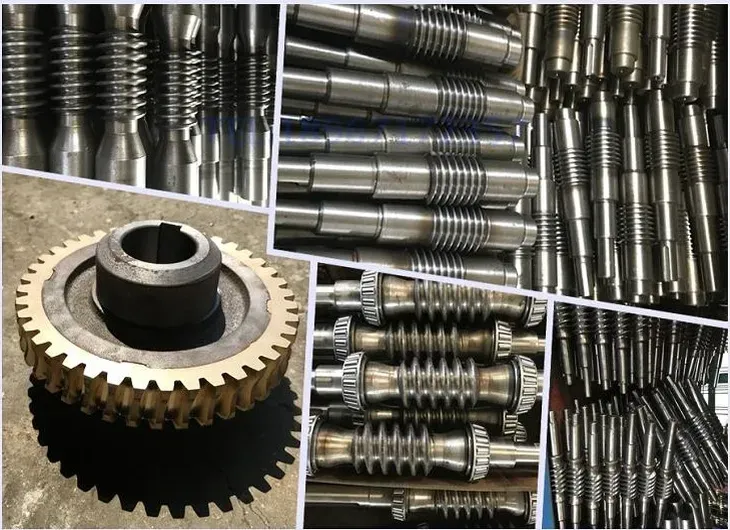
- Worm Shaft: 20CrMnTi alloy steel, carburised and quenched to HRC 56–62, thread flanks precision-ground to DIN 3975 Class 8 with Ra ≤ 0.8 μm surface roughness. Through-shaft configuration with both stubs produced in the same precision grinding fixture to ensure concentricity.
- Worm Wheel: ZCuSn10Pb1 tin-bronze, hobbed to conjugate geometry. Hardness HB 80–100 provides the optimal hardness ratio against the hardened worm shaft per AGMA 6034.
- Output Shaft: 45# chromium steel, h6 tolerance per DIN 748, DIN 6885 keyway dimensions. Compatible with standard Australian market couplings and sprocket hubs.
How to Select the WPW — Step-by-Step Guide
- Choose WPW over Standard W: Specify WPW when weight is a constraint (elevated mount, portable machine, Australian food processing lines where wash-down equipment must be easily removable), output shaft loads are within the standard WPA-equivalent bearing capacity, and size 200 is not required. Specify the standard W series when higher overhung load capacity or the size 200 range is needed.
- Calculate Ratio and Torque: Same methodology as WP and W series — divide motor speed by required output rpm; apply SF 1.25–2.0 to design torque; match to WPW frame catalogue rated torque. WPW rated torques follow the WPA convention at equivalent centre distances.
- Select Input Side: The through-shaft allows left or right input — select based on machine layout. Guard the unused input stub per AS 4024.1 with a cover plate before commissioning.
- Verify Thermal Rating: For Queensland and WA summer conditions (35–45 °C ambient), derate thermal power limit 10% per 10 °C above 20 °C reference. Specify synthetic ISO VG 220 oil if thermal margin is marginal — the aluminium housing in smaller WPW sizes (40–60) dissipates heat more quickly than cast-iron equivalents, providing a natural thermal advantage in warm ambient conditions.
Accessories We Also Supply: Through-shaft stub cover plates (AS 4024 compliant), flexible jaw and disc couplings, output sprockets (pilot bore and finished bore), replacement oil seals, and hand-wheel assemblies for secondary input stub. Contact Ever-Power Australia for pricing.
WPW Applications in Australian Industry
- Elevated Machine Positions (Sydney, Melbourne): Conveyors, packaging lines, and mixing equipment where the gearbox is mounted high on a machine frame and manual handling during maintenance is required — the WPW’s 3.5–20 kg range at sizes 40–80 allows one-person installation without mechanical lifting equipment.
- Food Processing (Brisbane, Adelaide): WPW units with IP65 motors flanged to the through-shaft via couplings, installed on mixer agitator brackets and conveyor support frames in Australian food and dairy plants. The lighter aluminium housing on smaller sizes (40–60) supports AS/NZS 4696 food machinery hygiene objectives and simplifies equipment movement during cleaning cycles.
- Textile and Packaging Machinery (Melbourne, Geelong): Encoder-equipped through-shaft drives for web tension control on fabric spreader and label applicator machinery, where the encoder mounts on the unused through-shaft stub without any additional bracket hardware.
- Agricultural and Irrigation Equipment (QLD, NSW, WA): Portable pump drives, irrigation system actuators, and seeder metering drives where the WPW’s compact, light housing reduces total implement weight and simplifies installation in field conditions.
What Australian Customers Say About the WPW Series
“WPW 60 units on elevated conveyor frames in our Sydney food plant — one of our fitters can swap a unit alone without any lifting equipment. At 8.5 kg, even the size 60 is manageable on a step ladder. The through-shaft means we get encoder feedback on the unused input side for our SCADA system at zero extra cost.”
— Pete M., Maintenance Manager, Sydney NSW
“Using WPW 50 units on our packaging label applicator rolls in Melbourne. The compact 6 kg housing fits in spots where the standard W or WP series simply won’t go. Self-locking at 40:1 holds the roll position during product changeover. 18 months of two-shift operation with no issues.”
— Claudia N., Packaging Engineer, Melbourne VIC
“WPW 80 on our irrigation actuator in regional QLD — light enough to carry and install in the field without a crane. Motor on one side, hand-wheel override on the other. It’s the lightest through-shaft worm reducer in this torque class we’ve found. Docking one star only because the stub cover plate needs to be ordered separately.”
— Phil A., Irrigation Technician, Darling Downs QLD
“We OEM WPW 70 units into our fabric tension control drives in Adelaide. The compact housing fits within the machine guard envelope while the through-shaft accommodates both the drive motor and the tension sensor encoder. Ever-Power’s supply has been consistent over 3 years of volume orders.”
— Sandra H., OEM Engineer, Adelaide SA
Why Choose Ever-Power for WPW Worm Gearboxes in Australia?
Ever-Power Worm Gear Reducer Co., Ltd. (Australia) at 27 Harley Crescent, Condell Park NSW 2200 stocks WPW units across all nine frame sizes for 5–10 business day dispatch. Our engineering team provides free WPW vs standard W vs WP selection guidance and confirms which unit best suits your weight, torque, and mounting requirements. Visit About Us. Technical reference at worm-gearbox.top.