Description
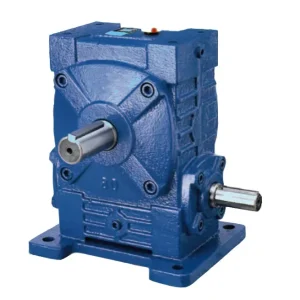
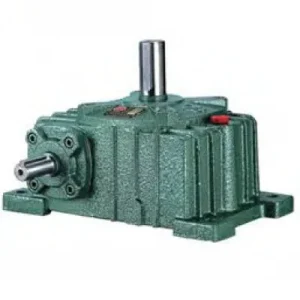
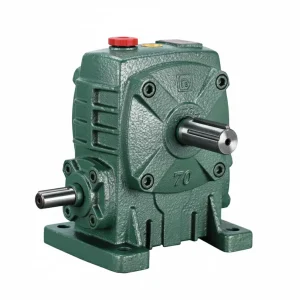
The WDX & WDO Series worm gear reducer delivers the W family’s highest configuration density — combining an IEC B5 motor-mounting flange at the input face with dual hollow bore outputs, eliminating every coupling in the drive chain simultaneously. The WDO presents two co-axial hollow bores on opposite housing faces: both driven shafts slide directly in from opposite sides of the reducer, rotating at mechanically identical speed at all times from a single flanged motor. The WDX routes one bore at 90° via an internal bevel stage, addressing machine layouts where the two driven shafts cannot be co-axial. Together, WDO and WDX provide the W family’s answer to the WP family’s WPDKO and WPDX series — the same zero-coupling, motor-direct, synchronised twin-output configuration, but built to the W series dimensional convention that Australian legacy machinery was engineered around. Covering sizes 50–155, input powers 0.18–5.5 kW, bore diameters Ø17–Ø60 mm, and ratios 10:1–60:1. Manufactured to ISO 9001:2015, designed per AGMA 6034, and supplied by Ever-Power Worm Gear Reducer Co., Ltd. (Australia), 27 Harley Crescent, Condell Park NSW 2200.
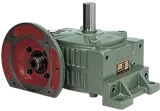

Key Specifications & Parameters — WDX & WDO Series
WDO — IEC Flange + Co-Axial Dual Bores
IEC B5 motor flange input (no coupling). Twin co-axial hollow bores on opposite faces — mechanically identical speed guaranteed. Best for parallel in-line synchronised shaft drives within W series machine layouts.
WDX — IEC Flange + 90° Dual Bores
IEC B5 motor flange input (no coupling). One bore co-axial with input axis; second bore exits perpendicular via bevel stage. Best for L-shaped twin-drive layouts in legacy W series machine envelopes.
| Size | Power (kW) | Ratio | A (mm) | B (mm) | BC (mm) | Bore Depth E1 (mm) | Flange LA (mm) | Output Bore Ø (mm) | Weight (kg) |
|---|---|---|---|---|---|---|---|---|---|
| 50 | 0.18 | 10:1–60:1 | 165 | 145 | 50 | 90 | 115 | Ø17 | 7 |
| 60 | 0.37 | 10:1–60:1 | 185 | 165 | 55 | 102 | 130 | Ø22 | 10 |
| 70 | 0.37–0.75 | 10:1–60:1 | 209 | 195 | 65 | 120 | 130 | Ø28 | 15 |
| 80 | 0.75–1.5 | 10:1–60:1 | 242 | 210 | 70 | 140 | 165 | Ø32 | 23 |
| 100 | 1.5 | 10:1–60:1 | 310 | 253 | 90 | 165 | 165 | Ø38 | 36 |
| 120 | 2.2–3.0 | 10:1–60:1 | 361 | 290 | 100 | 195 | 215 | Ø45 | 55 |
| 135 | 3.0–4.0 | 10:1–60:1 | 412 | 320 | 110 | 230 | 215 | Ø55 | 80 |
| 155 | 5.5 | 10:1–60:1 | 442 | 392 | 140 | 250 | 265 | Ø60 | 120 |
What Are WDX and WDO — Maximum Integration in the W Family
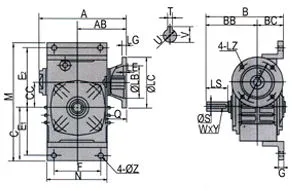
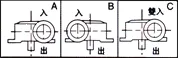
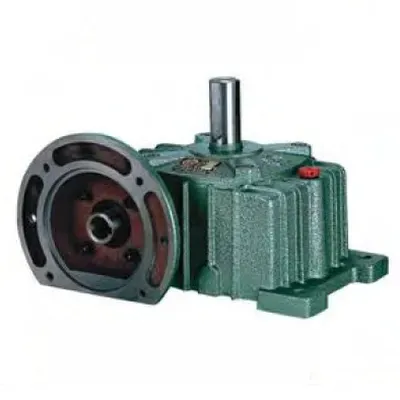
The WDX and WDO complete the W family configuration matrix at its most integrated point. They are the W family’s counterparts to the WP family’s WPDKO and WPDX series — providing the same three-feature combination (IEC motor flange input + dual hollow bore outputs + no external couplings) within the W series dimensional convention. In the W family matrix:
| W Family Model | Input Type | Output Count / Type | Couplings Required |
|---|---|---|---|
| WO / WX | Through-shaft coupling | Dual hollow bore (co-axial or 90°) | Input only |
| FCWDA / FCWDS | IEC B5 flange | Single hollow bore | None |
| WDO | IEC B5 flange | Dual hollow bore (co-axial) | None |
| WDX | IEC B5 flange | Dual hollow bore (90° offset) | None |
The practical value of the WDO over the WO for legacy Australian equipment is the elimination of the input coupling while maintaining W-convention bore dimensions. A WO-equipped machine that later requires IEC motor direct mounting — for an upgrade to a modern brake motor or servo drive — can be upgraded to WDO without changing the driven shaft dimensions, machine base mounting, or torque arm arrangement. The only difference at the machine interface is the input side: the WO’s through-shaft and coupling are replaced by the WDO’s IEC flange face and four motor bolts.
How to Select WDO or WDX — Four-Step Guide
- WDO or WDX? If both driven shafts are parallel and on the same axis (extending from opposite sides of the reducer symmetrically), specify WDO. If the second shaft must exit at 90° to the first, specify WDX. The IEC motor flange is on a single face in both variants — motor direction is independent of output geometry.
- Confirm W Convention vs WP Family: Verify driven shaft diameters against WDX/WDO bore Ø values (Ø17–Ø60 mm, W convention). If your shafts use WP-convention bore diameters (Ø17–Ø70 mm from WPDKO/WPDX), check whether the W bore matches — they often differ by 2 mm. When replacing an existing WO/WX unit, the WDO/WDX maintains bore diameter compatibility.
- Calculate Total Torque and Load Balance: Sum output torques from both driven loads (with SF 1.25–2.0) and confirm the WDO/WDX frame’s rated output torque is adequate. Confirm no single bore carries more than 70% of total rated torque alone — if unequal loading is possible (one load jams), specify a torque-limiting coupling on the lighter-loaded bore.
- Confirm IEC Motor Frame: WDO/WDX IEC flange acceptance follows the same motor-to-reducer size pairings as the FCWDA at equivalent frame sizes. Provide motor frame designation to Ever-Power for compatibility check before ordering.
Accessories We Also Supply: W-family torque arm kits (WDO/WDX specific), shrink disc assemblies for both output bores (Ø22+), IEC motor adaptor rings, torque-limiting couplings for unequal load protection, and DIN 6885 parallel keys. Contact Ever-Power Australia.
WDX & WDO Applications in Australian Industry
- Legacy W-Convention Twin-Roll Conveyor Upgrades (All States): Australian food and materials handling facilities upgrading WO-equipped twin-roll conveyors to modern IEC brake motors — the WDO replaces the WO with the same W-convention bore dimensions and no machine modifications, while eliminating the motor coupling that previously required periodic maintenance.
- Textile and Fabric Spreader Drives (Melbourne, Geelong): WDO on W-convention spreader roll drives where both rolls must advance at identical speed and the IEC motor must flange directly to the reducer for compact drive geometry. Retains W-series bore dimensions compatible with existing roll shafts.
- Agricultural Twin-Rotor Implements (QLD, NSW, WA): WDX on dual-auger fertiliser spreaders and twin-rotor cultivators built to the W series dimensional convention — the 90° output places the IEC motor above the implement frame while both rotor shafts exit at machine level, matching legacy implement designs originally drawn around the WX unit.
- Water Treatment Twin-Rack Gate Drives (Perth, Adelaide, Brisbane): WDO on irrigation gate drives in legacy W-convention infrastructure where both racks must advance identically — mechanical synchronisation eliminates differential advance that caused gate racking in VFD-synchronised systems, while IEC motor direct mount eliminates the coupling and motor base.
- Food Processing Twin-Scraper and Roller Drives (Sydney, Melbourne): WDO at sizes 60–80 on twin-scraper mixer drives and double-roll press drives in W-convention food machinery, where a single flanged IEC motor drives both rollers without any couplings at any interface.
What Australian Customers Say About the WDX & WDO Series
“Upgraded our Melbourne W-convention twin-roll conveyors from WO to WDO. Same bore dimensions, same machine base, same torque arm attachment — only the motor side changed. Motor swap to IEC brake motor took 15 minutes. Eliminated the motor coupling maintenance that cost us 4 hours per unit per year.”
— Thomas K., Plant Engineer, Melbourne VIC
“WDX 100 on our QLD dual-auger spreader rebuild. Original WX unit dimensions maintained — the rotor shafts slid straight in and the 112B5 motor flanged straight on. The IEC motor direct mount is significantly cleaner than the old coupling arrangement. Operating for 16 months without issue.”
— Rob F., Implement Engineer, Emerald QLD
“WDO 80 on our Perth twin-rack irrigation gate drive. Mechanical sync is perfect — no differential advance, no gate racking. IEC brake motor flanges directly. 4 stars because WDO can’t be upgraded to an FCWDS-type deeper bore — for our next build I might spec WPDKO instead. Great product otherwise.”
— Ian P., Water Infrastructure Engineer, Perth WA
“WDO 70 units for our Sydney food plant W-convention twin-scraper mixer drives. IEC 80B5 motor flanges directly, both scraper shafts enter the opposite bores, no couplings anywhere. The mechanical synchronisation is inherently correct — no VFD calibration, no speed drift over a production shift. Exactly what we needed.”
— Sarah W., Production Manager, Sydney NSW
Why Choose Ever-Power for WDX & WDO Worm Reducers in Australia?
Ever-Power Worm Gear Reducer Co., Ltd. (Australia) at 27 Harley Crescent, Condell Park NSW 2200 stocks WDO and WDX units across common frame sizes for 5–10 business day dispatch. Our engineering team provides free WO→WDO and WX→WDX upgrade assessments confirming dimensional compatibility before you commit to an order. Visit About Us and technical reference at worm-gearbox.top.