Description
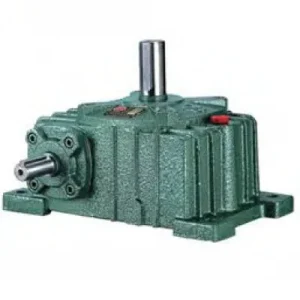
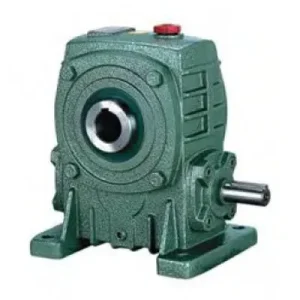
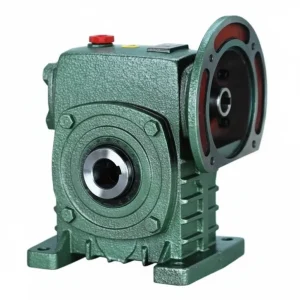
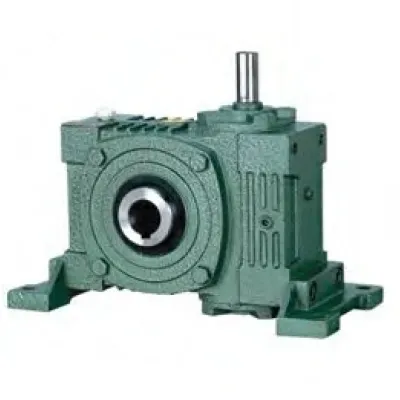
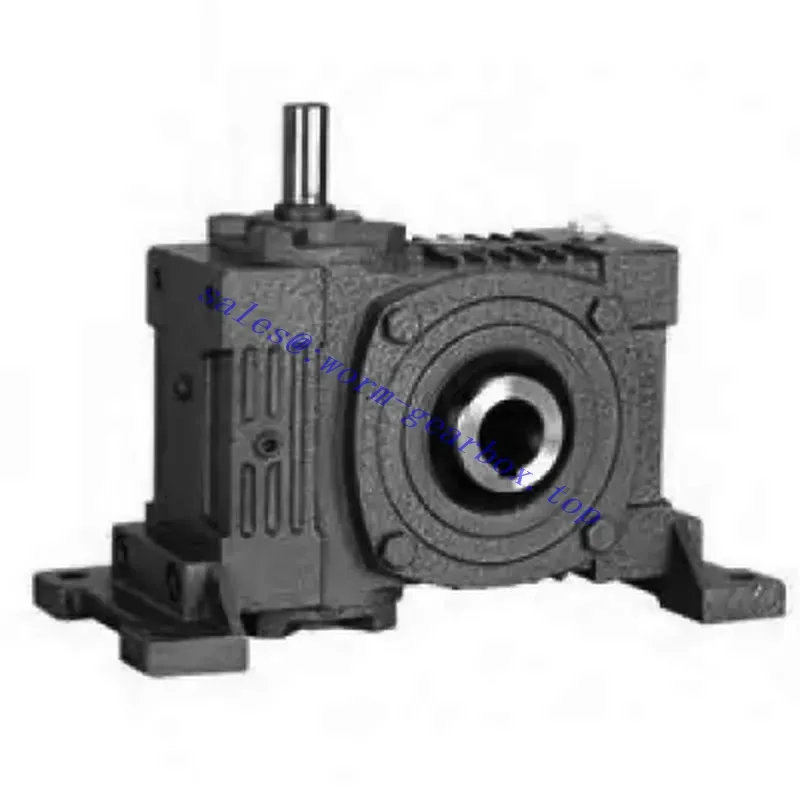
When Australian procurement engineers and plant maintenance managers need a right-angle worm reducer that offers mechanical self-locking, universal six-direction mounting, and a hollow output shaft for shaft-direct installation — all within a compact cast-iron or aluminium housing — the WPWKT series worm gearbox is the standard solution. Spanning frame sizes 40 to 250 with output torque from 17 N·m to 3,000 N·m, input power from 0.12 kW to 15 kW, and output speeds from 25 to 300 rpm, the WPWKT covers the operating range of the majority of slow-speed industrial drive applications across Sydney, Melbourne, Brisbane, and Perth. Unlike the dual-input WPWDKT, the WPWKT has a single input side — a simpler and more cost-effective configuration for applications where secondary input access is not required. Manufactured to ISO 9001:2015, designed to AGMA 6034, and supplied with full technical support by Ever-Power Worm Gear Reducer Co., Ltd. (Australia), 27 Harley Crescent, Condell Park NSW 2200.
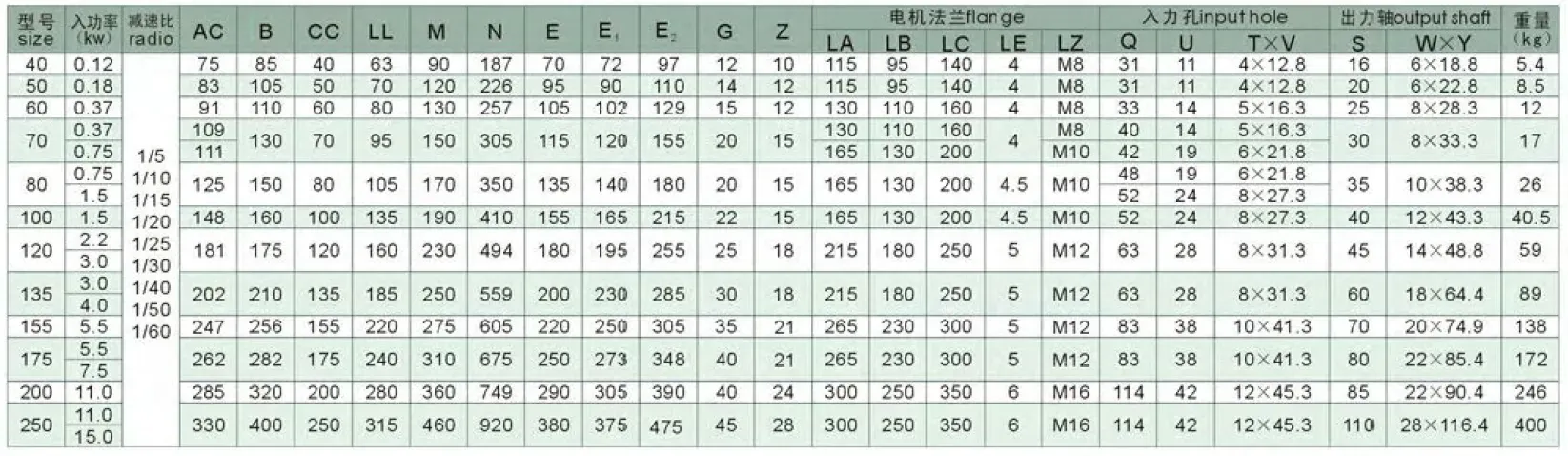
Key Specifications & Parameters — WPWKT Series Worm Gearbox
| Parameter | Specification |
|---|---|
| Model / Frame Sizes | WPWKT40, 50, 63, 75, 90, 110, 130, 155, 175, 200, 250 |
| Gear Ratio | 10:1, 15:1, 20:1, 25:1, 30:1, 40:1, 50:1, 60:1 |
| Input Power | 0.12 kW – 15 kW |
| Output Torque | 17 N·m (WPWKT40) – 3,000 N·m (WPWKT250) |
| Output Speed Range | 25 – 300 rpm (at 1,500 rpm input / 50 Hz) |
| Rated Input Speed | 1,500 rpm (4-pole motor, 50 Hz — Australian standard) |
| Output Type | Hollow output shaft (K); single input side |
| Housing Material | Cast iron or aluminium alloy (by frame size / configuration) |
| Weight Range | 5 kg (WPWKT40) – 500 kg (WPWKT250) |
| Mounting | Universal — all six orientations (W designation) |
| Self-Locking | At ratios 20:1 and above (lead angle <6°) |
| Manufacturing Method | Rolling gear (hobbed worm wheel); ground worm shaft |
| Gear Tooth Shape | Involute helicoid worm profile per DIN 3975 |
| Standard | ISO 9001:2015; AGMA 6034 rated torque & thermal power |
| Colour | Green / Grey / Blue / Custom |
Understanding Worm Gearbox Self-Locking — What It Means and When It Applies
The self-locking property of a worm gearbox is one of the most frequently cited — and most frequently misunderstood — features in the specification of worm drive gearboxes for Australian industrial applications. Understanding exactly when self-locking applies, and when it does not, is critical to safe machine design.
Self-locking in a worm gearbox occurs when the worm lead angle (helix angle of the worm thread) is less than the effective friction angle at the mesh contact. For the WPWKT series, self-locking is present at ratios of 20:1 and above — corresponding to a lead angle below approximately 6°. At ratios of 10:1 and 15:1, the lead angle is too steep for reliable self-locking, and the output can be back-driven by a sufficient load.
A critical distinction: self-locking prevents static back-driving — a stationary load cannot rotate the worm shaft. However, dynamic back-driving is possible under impact or vibration at the output — a falling load that generates a sudden impulse torque at the output can overcome the static friction threshold. For this reason, Australian Standards AS 4024 (machinery safeguarding) and AS 2550 (crane design standards) require a separate mechanical brake or backstop on all gravity-loaded drive systems, regardless of the self-locking characteristics of the gearbox. The WPWKT’s self-locking is a supplementary safety feature, not a substitute for a rated mechanical brake in life-safety applications.
How to Select the Right WPWKT Frame Size and Ratio
- Step 1 — Output Speed: Divide motor speed (1,450–1,500 rpm for 4-pole, 50 Hz Australian mains) by required output rpm to get ratio. Match to nearest available WPWKT ratio (10, 15, 20, 25, 30, 40, 50, or 60).
- Step 2 — Output Torque with Service Factor: Calculate T_design = (motor kW × 9,550 / output rpm) × SF. SF: 1.25 for conveyors and mixers; 1.5 for packaging and assembly; 2.0 for hoists and heavy shock. Select frame size where rated output torque ≥ T_design at your chosen ratio.
- Step 3 — Confirm Self-Locking Requirement: If the application requires self-locking (hoist, gate, valve), ensure you select a ratio of 20:1 or above. For ratios below 20:1, specify a separate mechanical brake.
- Step 4 — Specify Hollow Bore and Mounting: Confirm the driven shaft diameter matches an available WPWKT bore size. Specify mounting orientation from the six standard positions. Confirm oil fill port location for your orientation from the unit’s dimensional diagram.
- Step 5 — Check Thermal Rating for Australian Summer Conditions: At ambient temperatures above 35 °C (common in summer across Queensland, Northern Territory, and Western Australia), derate the thermal power limit by 10% per 10 °C above the 20 °C datasheet reference temperature. If the derated thermal power falls below the motor input power, specify synthetic lubricant or a larger frame size.
Related Accessories We Supply: IEC motor adaptor flanges (B5/B14), hollow shaft torque arms, output shaft shrink discs, input shaft coupling hubs, mounting feet kits, and replacement seals (NBR and Viton). Contact Ever-Power Australia for a bundled supply quote.
Applications Across Australian Industry — WPWKT Worm Gearbox
- Hoist & Lifting Equipment (Sydney, Melbourne): The self-locking property at 20:1 and above makes the WPWKT the first choice for overhead chain hoists, goods lifts, and racking elevation systems — where a stationary load must be held without power and without a separate brake engaging.
- Conveyor Equipment (Brisbane, Perth): Screw conveyors, belt conveyors, and spiral elevators moving product across Australian food and grain handling facilities rely on the WPWKT’s high torque density and low-maintenance hollow-shaft mount that eliminates the coupling and alignment tasks that are the most frequent cause of planned conveyor downtime.
- Packaging Machinery: Turntable drives, capper drives, and labeller in-feeds in Australian pharmaceutical and FMCG packaging plants use the WPWKT at ratios of 30:1 to 50:1, producing output speeds of 28–48 rpm from standard 4-pole motors without secondary reducers.
- Agricultural Machinery (QLD, NSW, VIC): Grain auger drives, irrigation boom drives, and poultry feeder chain drives in Australian agricultural facilities benefit from the hollow shaft direct-mount that eliminates exposed couplings prone to crop material fouling — a common cause of unplanned downtime in grain and poultry operations.
Customer Reviews — WPWKT Universal Worm Gearbox
“We use WPWKT 110 at 40:1 on our warehouse goods hoist in Sydney. The self-locking at 40:1 holds the pallet load perfectly when power is off — we removed the secondary electromagnetic brake that the old gearbox required and simplified our control panel significantly. Running 16 months with no issues.”
— Andrew S., Warehouse Manager, Sydney NSW
“WPWKT 90 at 30:1 drives our grain auger in regional NSW. The hollow shaft goes straight onto the auger tube shaft — no coupling to foul with grain dust. It’s been through two harvests now with just one oil change. Very impressed with the value for money from Ever-Power.”
— Mark H., Farm Machinery Operator, Dubbo NSW
“Replaced Lenze GBKH units on our Melbourne packaging turntables with WPWKT 63 at 50:1. Smooth, quiet, and runs at exactly the output speed we need with a standard 1500rpm motor. Only reason it’s not 5 stars is I had to email for a mounting orientation oil fill diagram — would be good to have this in the box.”
— Sandra K., Production Manager, Melbourne VIC
“We’re a conveyor OEM in Brisbane and have standardised on WPWKT for our hollow-shaft screw conveyor drives. Consistent quality batch to batch, fast supply from Condell Park, and the torque arms are available as a separate line item which is great for our spares kits. Highly recommended.”
— Cameron L., OEM Purchasing, Brisbane QLD
Why Choose Ever-Power for WPWKT Worm Gearboxes in Australia?
Ever-Power Worm Gear Reducer Co., Ltd. (Australia), 27 Harley Crescent, Condell Park NSW 2200, stocks the full WPWKT range with fast 5–10 business day dispatch. ISO 9001:2015 quality documentation, free engineering support, and 12-month warranty on all units. Learn more at our About Us page. Technical reference at worm-gearbox.top.